
Driving Bottom-Line Growth: The C-Suite Guide to Enterprise AI in E-Commerce

For enterprise e-commerce conglomerates, artificial intelligence has transcended its origins as an experimental technology or a rudimentary marketing adjunct for baseline product recommendations. In the contemporary landscape, AI embodies a paradigmatic architectural metamorphosis that exerts direct, quantifiable influence on gross margins, operational efficacy, and customer lifetime value (CLV).
We collaborate with global enterprises to execute high-impact Digital Commerce Transformations. Our expertise affirms that successful AI deployment transcends the acquisition of disparate software solutions; it necessitates the construction of a unified, data-centric ecosystem that propels scalable business acceleration.
Below elucidates how enterprise cognoscenti can harness AI intelligence to catalyze measurable financial parlay across their e-commerce infrastructure.
The Executive Stratagem: Architecting a Unified Data Foundation
AI models necessitate exquisitely curated, high-fidelity data to manipulate authentic business value. A cardinal impediment for enterprise empires is the deployment of isolated AI instruments that function in fragmented silos. To unleash genuine predictive intelligence, your AI layer must orchestrate data harmonization across your entire corporate biosphere.
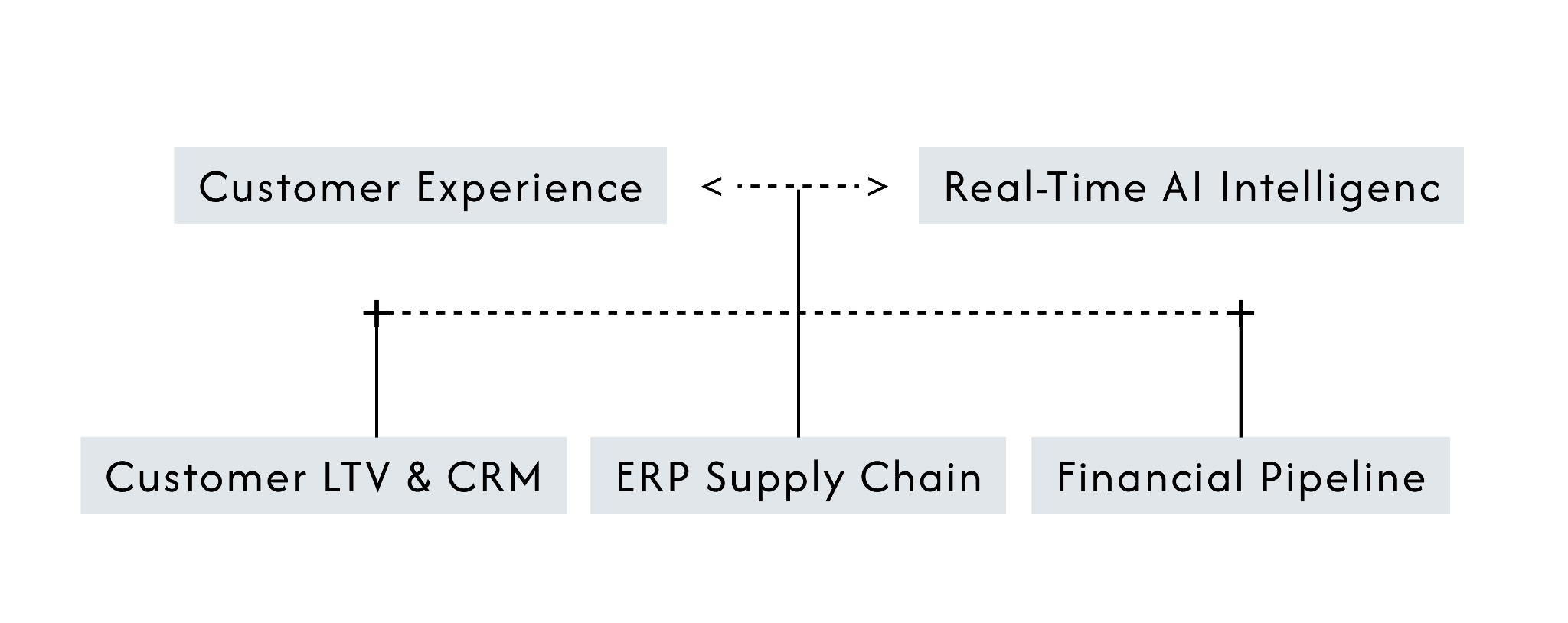
To drive precise business discernment, an enterprise AI stratagem must perpetually assimilate
Three High-ROI Use Cases for Enterprise E-Commerce
1. Predictive Supply Chains and Margin Optimization
Stockout catastrophes during peak seasonal virages directly annihilate revenue streams, while overstocking impounds critical working capital. By tethering machine learning algorithms directly to your Cloud ERP, AI can prognosticate regional demand trajectories weeks in precocity. This empowers executive cadres to automate inventory replenishment protocols and leverage location-aware synchronicity to position products proximate to high-demand latitudes, diminishing shipping expenditures and fortifying margin integrity.
2. Vector Search: Reclaiming Abandoned Revenue from Search Defections
Conventional keyword search inflicts multi-million dollar losses when customers fail to procure desired merchandise due to orthographic errors or syntactic complexity. Contemporary AI employs semantic search paradigms and Natural Language Processing (NLP) to decode human intent architecture. When a patron queries "heavy-duty waterproof boots for sub-zero outdoor work," the AI dissects the exact contextual nuance, instantly avoiding relevant product astrolabes and dramatically attenuating cart abandonment metrics.
3. Maximizing B2B Account Valuation with Predictive Ordering
In B2B e-commerce dominions, customer retention hinges on seamless, frictionless purchasing experientia. Machine learning algorithms interrogate historical wholesale order cadences to prognosticate precisely when an enterprise client approaches stock depletion. The platform then automatically fabricates personalized reorder templates or applies dynamic, volume-based pricing matrices tailored to that specific corporate contract, cementing predictable revenue streams.
Minimizing Implementation Peril
Deploying advanced AI capabilities within legacy, ossified e-commerce architectures often deleteriously impacts website performance. Latent loading velocities degrade user experientia and diminish search engine rankings, inverting the dividends of your AI investment.
To mitigate this existential risk, forward-thinking C-suite visionary leaders are pivoting toward modern, agile architectural paradigms:
By decoupling your front-end customer experientia from your back-end business logic via a Headless Commerce Architecture, your enterprise can deploy real-time personalization, intelligent search, and dynamic pricing matrices via high-velocity APIs without compromising system stalability.
A Phased Roadmap to AI Deployment
AI implementation must be strategically orchestrated to minimize operational friction and maximize initial parlay:
- Target Immediate Value Proposition: Begin with a measurable, high-ROI impediment, such as automating checkout workflows or reducing manual inventory ontology.
- Connect Core Systemic Pillars: Ensure your e-commerce platform, CRM, and ERP exchange data with seamless interoperability through modern API Integrations.
- Track Financial Metrics with Precision: Quantify success using explicit business key performance indicators (KPIs), including elevated conversion rates, diminished operational expenditures, and augmented average order value (AOV).
Scaling your existing infrastructure, transitioning to a flexible headless ecosystem, or injecting automation into your current technological stack necessitates an experienced technical symbiont.
Future-Proof Your E-Commerce Operations
At MLVeda, we design and engineer enterprise solutions that transmute complex data engineering into bottom-line accretion. Contact our executive strategy cadre today to deliberate how we can integrate advanced AI and automation into your digital commerce ecosystem.

